

Overview
Instantprint is one of the largest UK-based online printers, offering everything from flyers and business cards to stickers and more niche products like Heras banners.
With a large budget and an already established presence, the challenge wasn’t about getting traffic. It was about making the account more efficient and driving stronger profitability from existing spend.
In this case study, I’ll break down exactly how I approached the account, the strategy behind the changes, and the results achieved over the first year.
The Objective
instantprint operates in a highly competitive space, where margins, repeat purchases, and product demand all play a big role in overall performance.
Their product range includes:
Flyers
Business cards
Stickers
Posters
Heras banners (a key focus product)
The main objectives were clear:
Improve overall profitability
Focus budget on best-selling products
Increase total conversions
Prioritise conversions over ROAS due to strong returning customer rates
This last point is important. Because customers often reorder, the lifetime value is significantly higher than a single transaction. That meant we could justify more aggressive acquisition strategies.
Plan of Action
Before making any major changes, I focused on understanding where the account was underperforming and where the biggest opportunities were.
The initial plan centred around:
Identifying high-performing products and prioritising them
Reducing wasted spend, particularly within brand campaigns
Improving conversion efficiency across all campaigns
Testing different bidding approaches to find the lowest sustainable cost per conversion
This wasn’t about a complete overhaul. It was about refining what was already there and making it work harder.
PPC Strategy and Approach
With the objectives in mind, the strategy focused heavily on maximising conversions while bringing down costs.
1. Conversion-Focused Bidding
Rather than chasing ROAS, I prioritised conversion volume and efficiency.
This involved:
Regular bid adjustments based on performance
Testing different automated bidding strategies
Tight control over cost per conversion targets
2. Ongoing A/B Testing
A big part of improving performance came from continuous testing.
This included:
Ad copy variations
Different messaging for product categories
Testing offers and value propositions
Small improvements here compounded over time and played a big role in reducing costs.
3. Budget Reallocation
Not all products perform equally.
I shifted budget towards:
Best-selling products
High-converting search terms
Campaigns with proven profitability
At the same time, I reduced spend on underperforming areas.
4. Brand Spend Optimisation
One of the biggest wins came from tightening brand spend.
By reducing inefficiencies in branded campaigns, I was able to save around £4,000 per month without negatively impacting performance.
Results Achieved
Over the first year of working on the account, the improvements were significant.
Key results included:
Cost per conversion reduced by nearly 50%
Overall spend maintained at the same level
£4,000 per month saved through brand optimisation
Increase in total conversions
ROAS improved despite not being the primary focus
This is a good example of how focusing on the right metric, in this case conversions, can still lead to stronger overall account performance.
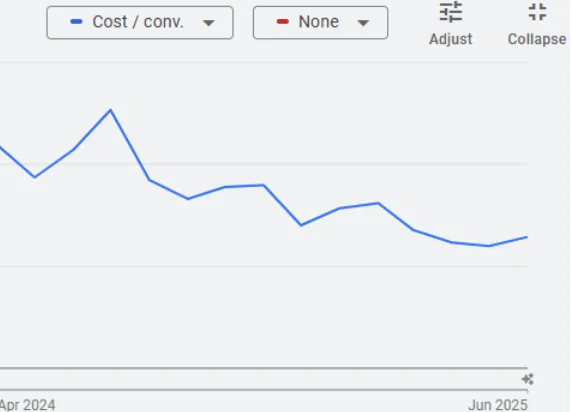
Cost / conv improvements
Significantly dropped over the first year period, leading to the best ever cost/conv for the account in the past 10 years.
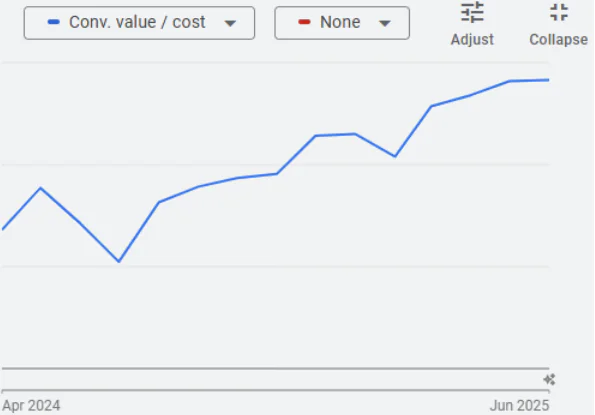
Return on ad spend (ROAS)
Made the account the most profitable it has ever been, almost doubling ROAS in a year.
Conclusion
This project shows what can be achieved when you focus on efficiency rather than just increasing spend.
By prioritising conversions, refining bidding strategies, and consistently testing, it’s possible to significantly improve performance even in well-established accounts.
Just as importantly, combining PPC with SEO created a more balanced and sustainable growth strategy.
If you're interested in professional PPC management to grow your business, feel free to get in touch via my contact page at jonnyswiftppc.com/contact. I'd be happy to discuss how PPC can work for you.