

One SEO issue I regularly speak to businesses about is duplicate content. A lot of website owners either do not realise they have it, or they assume it is not a major issue because the pages are technically live and working.
The reality is that duplicate content can seriously affect your SEO performance if it is not dealt with properly.
In this blog post, I’m going to explain exactly why duplicate content is an issue for SEO, what problems it can cause for your website, and how you can fix it properly.
Competing Pages
The biggest issue with duplicate content is competing pages.
When somebody searches on Google for a product, service, category page, or blog post, Google will normally only show one version of a page from a website in the search results.
This is because Google tries to work out which page on your website is the most relevant for that particular search query.
The issue starts when you have two pages with very similar or identical content.
This confuses the Google algorithm because it struggles to understand:
Which page should rank
Which page is the original
Which page is more useful for users
Which page should receive SEO authority
As a result, Google may:
Rank the weaker page instead of the stronger one
Constantly switch rankings between both pages
Reduce visibility for both pages
In some cases, choose not to rank either page well at all
This is why duplicate content becomes a genuine SEO problem.
Google cannot effectively push two nearly identical pages for the same search intent. It normally wants to prioritise one clear page.
So if your website has duplicate content, there is a strong chance one of those pages will struggle to appear on Google properly.
How to Fix Duplicate Content
The good news is that duplicate content is normally quite straightforward to fix.
What I usually recommend is identifying which page is performing best and keeping that one live.
The weaker duplicate page should then either be removed or redirected.
The most common fix is:
Keep the strongest page
Remove the duplicate page from Google
Add a 301 redirect from the duplicate URL to the main page
A 301 redirect tells Google and users that the old page has permanently moved to the preferred version.
This means:
Users still land on the correct page
Existing SEO authority can transfer
Google understands which page should rank
Duplicate content issues are reduced
In most cases, this is the cleanest and safest solution.
How Do I Find Duplicate Content?
Finding duplicate content is not always easy.
Tools like Google Search Console can sometimes hint at indexing or canonical issues, but they do not always clearly show duplicate content problems.
This is why I personally use tools like:
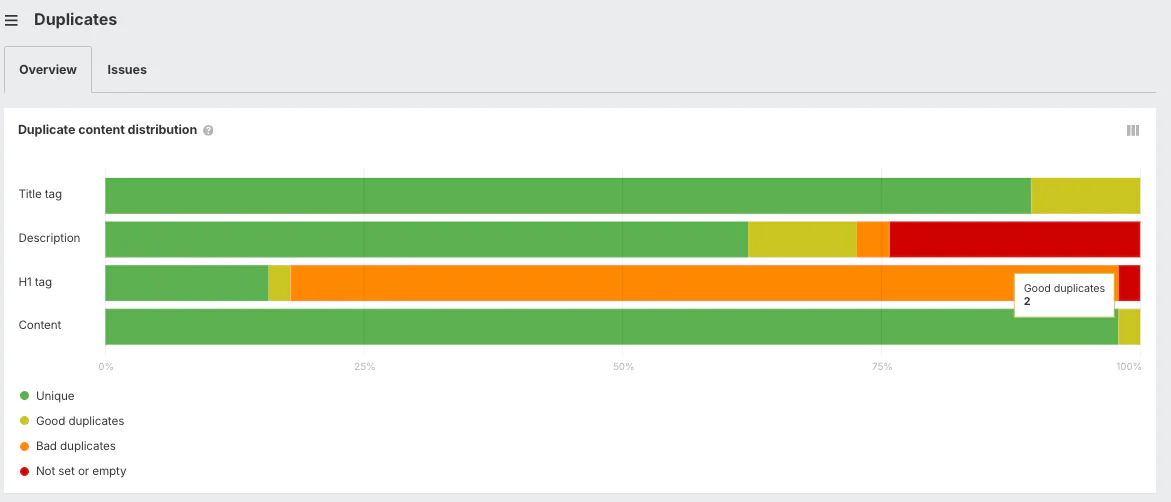
These platforms normally flag duplicate content issues directly inside their website audit tools.
You will often see warnings or errors related to:
Duplicate title tags
Duplicate meta descriptions
Duplicate page content
Canonical issues
Once I identify the duplicate pages, I can then decide:
Which page should stay
Which page should be removed
Whether a 301 redirect is needed
Whether the content simply needs improving
Why Fixing Duplicate Content Matters
A lot of businesses focus heavily on creating more pages, but quality and clarity matter more than quantity when it comes to SEO.
If Google becomes confused about which page to rank, your visibility can suffer even if your website has good content overall.
Fixing duplicate content can help:
Improve rankings
Strengthen keyword relevance
Consolidate SEO authority
Improve crawl efficiency
Create a better user experience
In many cases, cleaning up duplicate pages can produce noticeable SEO improvements without even creating new content.
Conclusion
Duplicate content is one of the more common SEO issues I come across when auditing websites.
The main problem is that it creates competing pages, which makes it difficult for Google to understand which page should rank in search results.
In a lot of cases, this can weaken both pages and reduce your visibility on Google.
Fortunately, it is usually a fairly simple issue to fix by removing weaker duplicate pages and implementing proper 301 redirects.
As a digital marketing consultant, I regularly help businesses identify technical SEO problems like duplicate content and improve their website performance through proper SEO strategy.
If you're interested in improving your website SEO or need help identifying duplicate content issues, feel free to get in touch via my contact page at Jonny Swift PPC. I'd be happy to discuss how I can help your business grow online.