

If you're running Google Ads campaigns, you might have heard something called TCPA. It isn't an abbreviation that most business owners hear day in and day out, so it's understandable if you're unsure what it means.
So, what is TCPA and how is it used within Google Ads?
In this guide, I'll explain exactly what TCPA is, how it works, the advantages and disadvantages of using it, and whether it's the right bidding strategy for your campaigns.
What Does TCPA Mean in Google Ads?
TCPA stands for Target Cost Per Acquisition.
Within Google Ads, Target CPA is used alongside the Maximise Conversions bidding strategy. It tells Google the average amount you'd like to pay for a conversion, such as a sale, lead form submission or phone call.
Google then uses its machine learning to automatically adjust bids in each auction to try and achieve as many conversions as possible while working towards your target CPA.
For example, if you're happy to pay £10 per lead, you could set your Target CPA to £10. Google will then attempt to generate conversions at around that average cost.
It's important to remember that not every conversion will cost exactly £10. Some may cost more, while others may cost less. The aim is to achieve your target cost on average over time.
What Are the Benefits of Using TCPA?
One of the main advantages of TCPA is that it helps provide more control over your cost per conversion.
If you're using Maximise Conversions without a target, Google will simply try to generate as many conversions as possible within your budget. While this can work well, it may lead to higher acquisition costs.
Adding a Target CPA gives Google an efficiency goal to work towards.
Some of the benefits include:
Better control over your average cost per acquisition
Reduced manual bid adjustments
The ability to scale campaigns while maintaining efficiency
Google's machine learning optimising bids in real time
Potential improvements in profitability if your target is realistic
In many accounts, I've found that introducing a sensible Target CPA can improve overall efficiency compared with using Maximise Conversions alone.
However, the target needs to be based on real performance data.
TCPA vs Target ROAS: What's the Difference?
Although both are automated bidding strategies, they focus on different objectives.
Target CPA
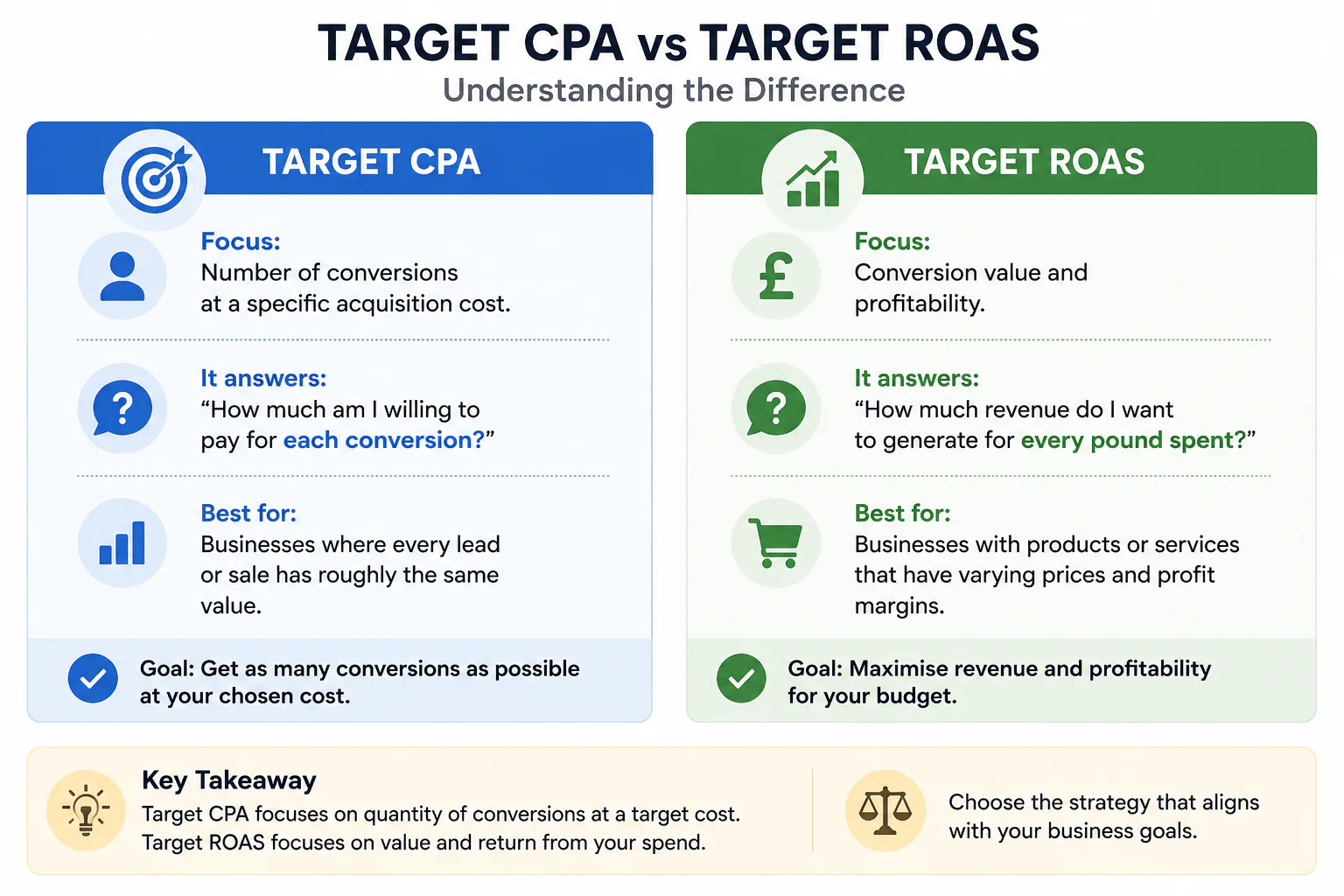
Target CPA focuses on the number of conversions you generate at a specific acquisition cost.
It answers the question:
"How much am I willing to pay for each conversion?"
Target ROAS
Target ROAS focuses on conversion value and profitability.
It answers the question:
"How much revenue do I want to generate for every pound spent?"
For example, if you sell products with varying prices, Target ROAS may prioritise higher-value products because they generate more revenue.
Target CPA, on the other hand, simply aims to acquire conversions at your chosen cost.
If every lead or sale has roughly the same value, TCPA can work extremely well. If profitability varies significantly between products or services, Target ROAS may be a better option.
What Are the Downsides of TCPA?
Although TCPA can be highly effective, there are some limitations to be aware of.
Setting the target too low
One of the biggest mistakes advertisers make is setting an unrealistic Target CPA.
If Google believes it cannot achieve conversions at that price, your campaigns may struggle to spend budget and traffic volume can decrease significantly.
I often test lowering the Target CPA gradually to improve efficiency. However, there usually comes a point where pushing it any lower starts to restrict performance.
That's simply the nature of the strategy.
Budget limitations
Another issue occurs when advertisers have a large budget but an extremely low Target CPA.
In these situations, Google may not be able to spend the full budget because there aren't enough opportunities that meet the target you've set.
You may also see a ‘limited by target’ warning.
Profitability concerns
Sales and leads are important, but profitability matters even more.
If your products have different profit margins, focusing solely on CPA may not always be the best approach.
In these cases, Target ROAS could provide a better balance between growth and profitability.
How to Set a TCPA in Google Ads
Setting up a Target CPA is straightforward.
Open your Google Ads campaign.
Navigate to Campaign Settings.
Select Bidding.
Choose Maximise Conversions.
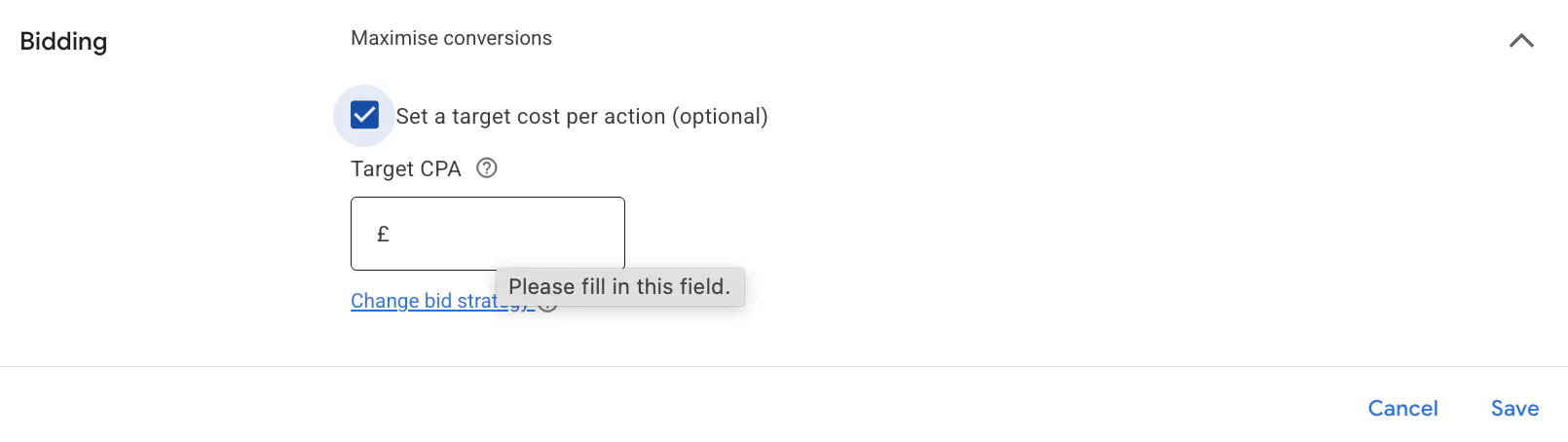
Tick the option to Set a target CPA.
Enter your desired Target CPA amount.
Save your changes.
Target CPA is commonly used in:
Search campaigns
Performance Max campaigns
If you've previously been using Maximise Conversions, I generally recommend starting with a Target CPA that's close to your existing average CPA.
From there, monitor performance over several weeks and test reducing the target gradually if results remain strong.
The key is to make adjustments carefully rather than making aggressive changes overnight.
Is TCPA Right for Your Business?
Target CPA can be an excellent bidding strategy if:
You have reliable conversion tracking in place
Your leads or sales have relatively similar values
You want more control over acquisition costs
Your campaigns already generate a reasonable amount of conversion data
However, if profitability varies significantly between products or services, Target ROAS may be the more appropriate choice.
As with most things in Google Ads, there isn't a one-size-fits-all solution. Testing and ongoing optimisation remain essential.
Conclusion
TCPA, or Target Cost Per Acquisition, is a smart bidding feature designed to help advertisers generate conversions at a target average cost.
When used correctly, it can improve efficiency, reduce wasted spend and provide greater control over acquisition costs. However, setting unrealistic targets can restrict campaign performance, so it's important to base your decisions on real data.
If you're interested in professional PPC management to grow your business, feel free to get in touch via my contact page at jonnyswiftppc.com/contact. I'd be happy to discuss how Google Ads can work for your business.