

If you have recently started running Google Ads, you may have looked at your average CPC and wondered whether you are paying too much.
Is your CPC expensive? Is it reasonable for your industry? Or is it exactly where it should be?
The short answer is that there is no single CPC that counts as good for every business. A good CPC is one that allows you to attract relevant traffic and generate profitable leads or sales within your budget.
In this guide, I’ll explain what CPC means, why it matters, how to compare your CPC with the wider market and which metrics you should prioritise when judging performance.
What Does CPC Mean in Google Ads?
CPC stands for cost per click. It tells you how much you pay each time somebody clicks your advert.
Your average CPC is calculated using this formula:
Total advertising cost ÷ total clicks = average CPC
For example, if you spend £100 and receive 20 clicks, your average CPC is £5.
This is different from your maximum CPC bid. Your maximum bid is the most you are normally willing to bid for a click, whereas your average CPC shows what you have actually paid across multiple clicks.
Google provides a more detailed explanation in its average CPC definition.
What Is Considered a Good CPC?
A good CPC is one that makes commercial sense for your business.
It should allow you to receive enough clicks for your budget while still giving you a realistic opportunity to generate profitable conversions.
A £20 CPC could be perfectly acceptable for a business selling a valuable service with long-term retainers. Meanwhile, a CPC of 50p could still be poor value if the clicks are irrelevant and never turn into customers.
This is why I would not judge a CPC by the number alone. You need to consider:
- Your industry
- The value of a lead or sale
- Your conversion rate
- Your profit margin
- The quality of the traffic
- Your total available budget
Does Your CPC Work With Your Budget?
CPC gives you an indication of how many clicks your campaign budget can buy.
As a starting point, I generally recommend having enough budget to generate at least around ten clicks per day. This is not a fixed Google requirement, but it gives your campaign more opportunities to collect useful data and generate conversions.
For example, if your expected CPC is £10:
- £10 average CPC
- 10 clicks per day
- £100 suggested daily campaign budget
If you only had a daily budget of £20, that same campaign might receive approximately two clicks per day. It could take much longer to collect enough data to judge performance properly.
This is why researching CPC before launching a campaign can help you set a more realistic Google Ads budget.
Use Google Keyword Planner to Compare CPCs
The first place I recommend checking is Google Keyword Planner.
You can find it in Google Ads by going to:
Tools → Planning → Keyword Planner → Discover new keywords
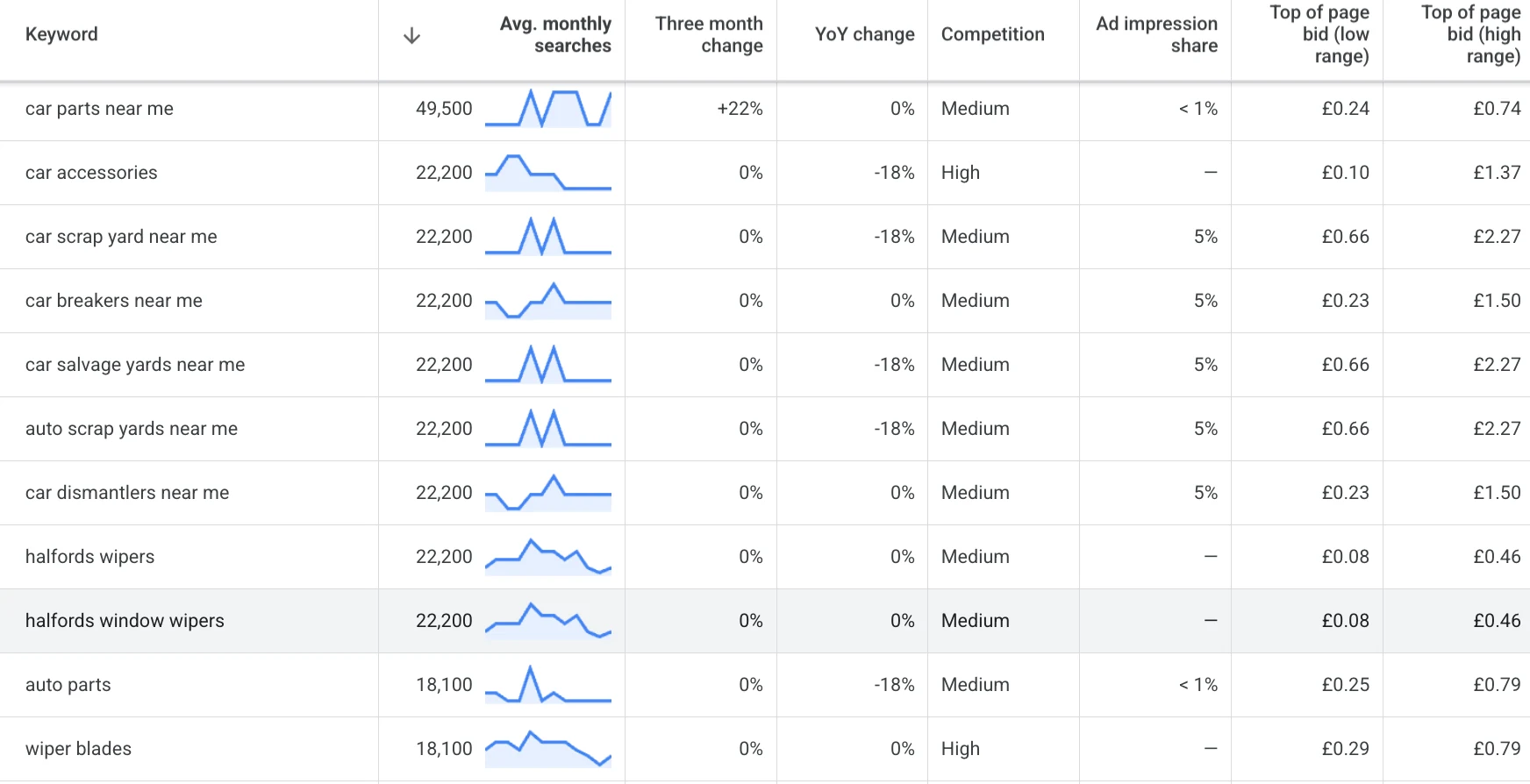
Enter a keyword that represents the product or service you want to advertise. Google will then show information including:
- Average monthly searches
- Competition
- Top-of-page bid, low range
- Top-of-page bid, high range
Google describes the low and high ranges as approximations of the 20th and 80th percentiles historically paid by advertisers whose ads appeared at the top of the results. The figures depend on factors such as your chosen location and Search Network settings. They should therefore be treated as estimates rather than guaranteed prices. Google explains these Keyword Planner figures here.
If your average CPC falls somewhere within that range, it is a useful indication that you are not paying an unusual amount compared with the market.
However, being inside the range does not automatically make the CPC profitable. Your actual costs will also be affected by competition, targeting, ad relevance, bidding and the quality of your landing page.
Work Out Whether the CPC Makes Sense for Your Business
Industry comparisons are helpful, but your own numbers are more important.
Suppose you sell a product for £10 and your website has a conversion rate of 10%. On average, you would need ten clicks to generate one sale.
If each click costs £2:
- 10 clicks would cost £20
- A 10% conversion rate would produce approximately one sale
- That sale would generate £10 in revenue before product costs
In that example, the advertising would be unlikely to make financial sense unless customers purchase additional products or provide significant repeat value.
A simple way to estimate an affordable CPC is:
Acceptable cost per conversion × conversion rate = target CPC
If you are willing to pay £100 for a lead and your click-to-lead conversion rate is 10%, a CPC of approximately £10 may be workable:
£100 × 10% = £10
For lead-generation businesses, you should also consider how many leads turn into paying customers. Generating cheap enquiries is not helpful if none of them are suitable.
You can read my guide to calculating conversion rate in Google Ads if you are unsure which figure to use.
A Higher CPC Is Not Always a Bad Thing
Some of the most valuable searches are also the most competitive.
If a £20 click eventually contributes towards winning a profitable long-term contract, paying £20 may be completely reasonable.
The opposite is also true. You could generate hundreds of very cheap clicks, but they have little value if the visitors are searching for the wrong thing or never become customers.
When reviewing CPC, look at it alongside:
- Conversion rate
- Cost per conversion
- Lead quality
- Revenue
- Conversion value
- Return on ad spend
- Overall profit
The aim is not necessarily to get the cheapest possible traffic. It is to get the right traffic at a cost your business can sustain.
Things to Know About CPC on a New Campaign
If your campaign has only recently launched, your CPC may fluctuate while you collect data and refine the account.
During the first few weeks, you may still need to:
- Remove irrelevant search terms
- Add negative keywords
- Adjust keyword match types
- Improve your adverts
- Refine location and device targeting
- Improve your landing pages
- Review your bidding strategy
Improving relevance and Quality Score may help reduce CPC, but simply leaving a campaign running does not guarantee that costs will fall. The account still needs to be monitored and improved.
I would avoid making a final judgement based on a small number of early clicks. However, you should still check that the campaign is attracting relevant searches and is not spending heavily in the wrong places.
Does Automated Bidding Reduce CPC?
Not necessarily.
Automated bidding sets bids according to the objective you choose. For example, Maximise Conversions aims to generate as many conversions as possible within the available budget. Google may pay a higher CPC when it predicts that a particular click is more likely to convert.
Target CPA and Target ROAS can help give Google a clearer efficiency goal:
- Target CPA works towards an average cost per conversion.
- Target ROAS works towards a target return based on conversion value.
These strategies can improve overall efficiency when the account has reliable conversion tracking and sensible targets. However, their main purpose is not to produce the lowest possible CPC.
Your CPC could increase while your cost per conversion or return improves. That can still be a positive result.
You can read my guide to Target CPA in Google Ads for a more detailed explanation.
What Should You Focus on Instead of CPC?
Although CPC is useful, profitability should be your main focus.
CPC, click-through rate and other supporting metrics can indicate whether an account is moving in the right direction, but they do not prove that a campaign is successful by themselves.
You could have:
- High CPCs and excellent returns
- Low CPCs and no profitable customers
- A strong click-through rate but poor lead quality
- Fewer conversions but much higher-value sales
The important question is whether Google Ads is producing results that make financial sense for your business.
So, What Is a Good CPC for Google Ads?
A good CPC is not a particular number. It is a cost that allows you to attract relevant clicks and generate profitable results within your budget.
Use Google Keyword Planner to understand the likely price range for your keywords, then compare that estimate with your conversion rate, customer value and acceptable cost per acquisition.
Do not focus on lowering CPC at the expense of traffic quality. A more expensive click can be worth paying for when it produces a valuable customer, while a cheap click is still wasted money if it produces nothing.
If you would like an independent opinion, I can provide a free Google Ads audit and show you where your budget is being spent, what may be pushing costs up and where the strongest opportunities are.