

One question I often see online is whether outbound links actually help SEO.
You’ve probably seen people recommending that you add links within blog posts to other websites, studies, tools, or sources. But does linking away from your own website really improve rankings? And if it does, why?
The reality is that outbound links are not some magic SEO trick that suddenly boosts rankings overnight. However, when used properly, they can improve credibility, strengthen your content, and enhance the user experience, all of which can indirectly support SEO performance.
In this article, I’ll explain exactly how outbound links can help SEO, when they make sense to use, and some important best practices to follow.
What Are Outbound Links?
Outbound links are links from your website to another website.
For example, if you reference:
Government statistics
Educational resources
Industry studies
Official documentation
Books or research papers
…and link directly to those sources, that would count as an outbound link.
These links help support the information you are discussing and provide users with additional context or evidence.
Outbound Links and SEO Validation
Credibility and E-E-A-T
One of the biggest reasons outbound links can help SEO is validation.
Google places a strong focus on credibility, trust, and E-E-A-T, which stands for:
Experience
Expertise
Authoritativeness
Trustworthiness
If you're writing a blog post discussing a product, topic, or statistic that you do not directly own or sell, linking to authoritative sources can strengthen the credibility of your content.
For example, linking to:
Government websites
Educational domains
Official research studies
Trusted industry publications
…can help show both users and search engines that your content is well researched and backed by reliable information.
Google does try to understand where information originates from. Referencing trustworthy sources can reinforce the legitimacy of the points you are making.
That’s especially important in industries where accuracy matters, such as:
Finance
Healthcare
Legal
Marketing
Technology
Outbound Links Can Improve User Experience
Another major benefit of outbound links is improving the user experience.
Most people reading blog content are looking to learn something or validate information. Sometimes giving users direct access to supporting resources genuinely helps them.
For example, if you mention:
A Google algorithm update (keep informed with the Search Engine Journal)
SEO statistics
Research data
Industry studies
Technical documentation
…it can be useful to link directly to the original source.
Even if the user leaves your website temporarily, you are still helping them get the answers they originally wanted.
This can improve:
Trust in your content
Perceived expertise
Overall user satisfaction
Content usefulness
In many cases, that is more valuable long term than trying to keep users trapped on your website unnecessarily.
Do Outbound Links Directly Improve Rankings?
This is where things get slightly misunderstood.
There is no confirmed evidence that simply adding outbound links automatically increases rankings on its own.
However, outbound links can contribute to factors that support better SEO performance, including:
Better content quality
Increased trust signals
Improved topical relevance
Enhanced user experience
Stronger content validation
So while outbound links are unlikely to be a direct ranking factor by themselves, they can absolutely support a stronger SEO strategy overall.
That value extends beyond traditional SEO into AI-driven search. Platforms like AirOps encourage authoritative sources and citations as part of modern content workflows, reinforcing how trustworthy outbound links can improve content quality, credibility and user experience. Used naturally, they are a hallmark of well-researched, authoritative content.
The key is using them naturally and appropriately.
Best Practices for Using Outbound Links
1. Link to Relevant, High-Quality Websites
Always make sure the websites you link to are trustworthy and relevant to the topic.
Good examples includes
Government websites
Educational websites
Official company sources
Trusted publications
Well-known industry resources
Avoid linking to spammy or low-quality websites purely for the sake of adding links.
The source should genuinely support the point you are making.
2. Make Sure Your References Are Accurate
Before linking to anything, verify the information is actually correct.
Outdated or inaccurate sources can damage credibility rather than improve it.
If you are quoting statistics, studies, or claims, always check:
Publication dates
Source reputation
Accuracy of the information
Whether newer data exists
3. Avoid Overlinking
One of the biggest mistakes people make is adding too many outbound links.
Do not go overboard.
In most cases, it is more important for users to stay engaged with your own website. Only add outbound links where they are genuinely useful and relevant.
A few high-quality references are usually far more effective than dozens of unnecessary links.
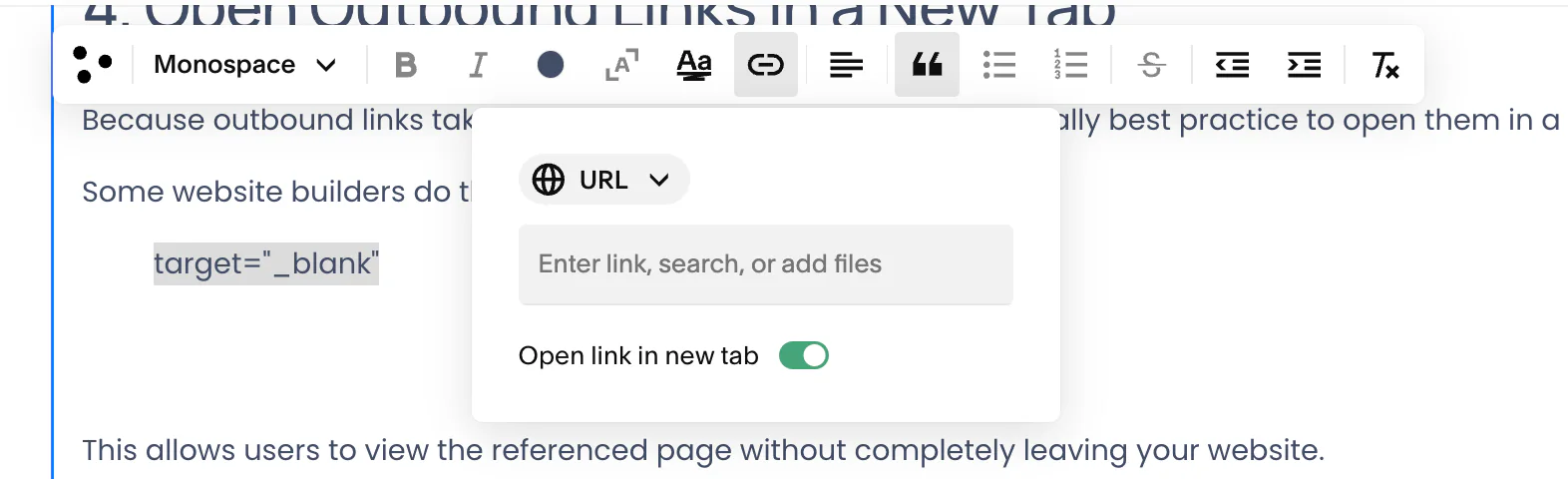
4. Open Outbound Links in a New Tab
Because outbound links take users away from your website, it is usually best practice to open them in a new tab.
Some website builders do this automatically, but if not, you can use:
target="_blank"
This allows users to view the referenced page without completely leaving your website.
It helps preserve the browsing experience while still giving users access to useful resources.
When Should You Use Outbound Links?
Outbound links work best when:
Supporting factual claims
Referencing statistics
Citing research
Providing additional context
Linking to official sources
Improving educational content
You do not need them on every page.
Use them where they naturally improve the quality of the content.
Conclusion
So, do outbound links help SEO?
In my experience, yes, but mainly in an indirect way.
Outbound links can improve credibility, support E-E-A-T signals, validate your content, and enhance the overall user experience. They help demonstrate that your content is well researched and genuinely useful rather than simply written to rank.
That said, they should always be used thoughtfully. Focus on linking to relevant, trustworthy sources and avoid excessive linking that distracts users from your own website.
If you're interested in improving your SEO strategy or need support growing your business online, I’m a digital marketing consultant specialising in SEO and PPC. Feel free to get in touch via my contact page at Jonny Swift PPC and I'd be happy to discuss how digital marketing can work for your business.