

Looking to get more enquiries for your physiotherapy clinic? Google Ads can help you reach people already searching for a physio, rather than waiting for them to discover your business while scrolling through social media.
For a physiotherapist, the location and the service both matter. Someone might want a nearby clinic for a first assessment, while another person is specifically looking for sports physiotherapy or rehabilitation. Your ads need to make it clear that you offer the help they’re searching for, somewhere they can realistically get to.
In this guide, I’ll explain how I would approach Google Ads for physiotherapists, including local targeting, Google Business Profile, ad groups, landing pages and setting a budget.
What Is Google Ads for Physiotherapists?
Google Ads lets you pay to advertise your clinic. With Search ads, you choose keywords related to your services, write ads and send people to a relevant page on your website. You normally pay when someone clicks, which is why it’s called PPC, or pay per click.
For example, someone searching for “sports physiotherapy Leeds” could see an ad for your sports physio service and click through to find out about an appointment.
Search is the starting point I would focus on here. You can reach people actively looking for a service, but you still need to make sure the clicks are relevant and the page makes it easy to enquire.
1. Create a Search Campaign for Your Clinic
If you haven’t already, create your Google Ads account, add your billing details and complete any advertiser verification tasks Google requests. My guide to creating a Google Ads account from scratch covers the account setup.
Then create a Search campaign focused on enquiries or bookings. Before adding keywords, decide which physiotherapy services you want to promote and which appointments you have capacity to take.
A clinic offering general physiotherapy will need different messaging from a practice specialising in sports injuries. You don’t need to promote everything in the same ad just because it’s all available at the same address.
2. Target People Who Can Reach Your Practice
Most people booking an appointment at a physiotherapy clinic need to visit in person. They may be comparing several practices and checking which one is close to home, work or their usual travel route.
Choose locations around your clinic that reflect how far people are likely to travel. That might mean a town, selected nearby areas or a radius around the practice. A national campaign is unlikely to make sense for a clinic serving one local area.
Check the location options too. Google can include people who show an interest in your selected area as well as people located there. For a local clinic, targeting people in or regularly in your chosen area is often a better fit. Google explains those location options here.
Make the location clear in your ads and on the landing page. A potential patient shouldn’t have to search around your website to work out where an appointment would take place.
3. Link Your Google Business Profile and Use Location Assets
I would also link your Google Business Profile to Google Ads and use location assets. These let Google include information about your clinic’s location with eligible ads, helping people see where you are and find directions.
For a physiotherapist, that’s particularly useful. People might like the look of your services, but if the clinic is too far away, they’re unlikely to book.
The screenshot below shows a “Sponsored places” section featuring local clinics. You can see how the area, business details, photos and opening information help people compare nearby options before visiting a website.
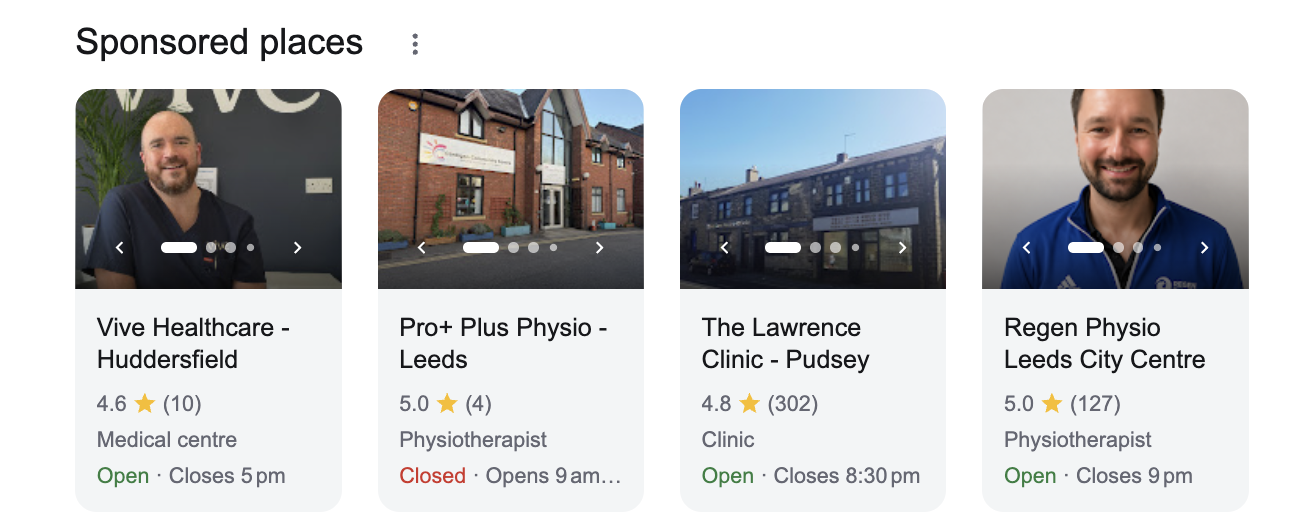
Search campaigns with location assets can also be eligible to show ads on Google Maps. Linking your profile supports that eligibility; it doesn’t guarantee a sponsored placement or mean your ads will only run on Maps. See Google’s guidance on local search ads on Maps.
Use the Business Profile for your actual clinic and check the address, phone number, opening hours and website. If you have several locations, check that the right location assets are associated with each campaign. Google’s location assets guide explains the linking options.
4. Separate Your Services into Relevant Ad Groups
If you specialise in rehabilitation, give that service its own ad group. The same applies to sports physiotherapy if it is a separate part of your offering. That lets you match your keywords, headlines and landing page to what the person actually wants.
For a clinic offering all three, an example structure could be:
- General physiotherapy: searches such as “physio near me” and “physiotherapy clinic Leeds”, with ads about local physiotherapy appointments.
- Sports physiotherapy: searches such as “sports physiotherapy Leeds”, with ads and a page focused on your sports physio service.
- Rehabilitation: searches about the specific rehabilitation services you provide, with a page explaining those services and the appointment process.
These are examples, rather than a keyword list every clinic should copy. Only include services you actually offer. “Rehabilitation” on its own can describe very different services, so make the keywords specific to your work.
If sports physiotherapy is your main service, make that the focus of the ads. A generic therapy message is less helpful than a clear explanation of why your service fits that search.
5. Write Ads That Match the Problem and the Service
People searching for a physiotherapist usually want help with a particular problem. Your ad should explain the types of issues your clinic works with and the service they can book, while keeping the wording accurate.
For example, if they fit your clinic, headlines could include:
- Physiotherapy in Leeds
- Sports Physio Appointments
- Injury Rehabilitation
- Book a Physio Assessment
- Local Physiotherapy Clinic
A description could be: “Sports physiotherapy in Leeds. Explore our services and book an initial assessment.”
Add genuine reasons to choose your clinic, such as convenient appointment times, a useful location or relevant practitioner experience. Avoid promising that you can fix every problem or guarantee recovery. Be clear about what you assess and treat, and let the page explain the details.
For more on building the message, see my guide to writing PPC ad copy.
Send Each Ad to the Right Landing Page
If the keyword is about sports physiotherapy and the headline says sports physio, the page should explain that service. Sending everyone to a general homepage makes them do extra work to find the information they clicked for.
Your landing page should make the service, clinic address, practitioner information and next step easy to find. Explain how an assessment works, include fees or booking information where appropriate, and make the contact form or booking button easy to use on a phone.
My guide to PPC landing pages explains why that connection between the search, ad and page matters.
6. Work Out Your Physiotherapy Google Ads Budget
When looking at searches for this guide, I saw indicative costs of roughly £2–£5 per click for physio searches and £1–£7 for sports physiotherapy. These are observations from the searches I looked at, rather than fixed prices or UK-wide averages.
The amount you pay will depend on your location, keywords, competition and campaign performance. Check current Keyword Planner estimates for your own area and services before choosing a budget.
My starting recommendation is to plan for 10 clicks per day. Multiply the estimated CPC by 10 for your daily budget, then multiply that by 30.4 to estimate a monthly budget:
- Physio at £2–£5 per click: £20–£50 per day, or approximately £608–£1,520 per month.
- Sports physiotherapy at £1–£7 per click: £10–£70 per day, or approximately £304–£2,128 per month.
For example, a £3 CPC × 10 clicks = £30 per day. £30 × 30.4 = £912 per month in ad spend, before any management fees.
These figures help you plan a test; they don’t guarantee 10 clicks every day or a particular number of patients. If you split the budget between several services, that is 10 clicks across the campaign, not automatically 10 for every ad group. Adjust the scope to what you can afford.
My guide on how much to spend on Google Ads explains this calculation in more detail.
7. Add Negative Keywords and Review Your Search Terms
Physiotherapy keywords can still bring in irrelevant searches. General therapy terms, training courses, job searches or types of rehabilitation you don’t offer can all take the campaign away from the services you want to advertise.
Check the search terms that triggered your ads and add negative keywords where the intent is wrong. For example, a counselling search is different from someone looking for a physiotherapy appointment.
Be careful with broad exclusions. Blocking the word “therapy” everywhere could also block a relevant phrase for a service you offer. Exclude the unwanted search intent without cutting off useful enquiries.
Use my guides to finding search terms and checking negative keywords to keep reviewing what your budget is paying for.
8. Track Enquiries and Judge the Campaign by Bookings
Before launch, check that successful contact forms and completed bookings are recorded correctly. Track phone number clicks too, but remember that clicking a number doesn’t prove somebody had a conversation or booked an appointment. My conversion tracking guide covers testing the setup.
If you mainly take bookings by phone, schedule ads for times when someone can answer. If patients can book online outside clinic hours, a wider schedule may make sense.
Keep measurement focused on the action, without sending symptoms, treatment notes or form answers to advertising tools. Google restricts enhanced conversions involving sensitive health information under its customer data policies. Health-related services can also face restrictions on personalised targeting, so check Google’s health advertising rules before adding remarketing or customer lists.
I normally recommend allowing at least three months to assess Google Ads properly, with an affordable budget and regular improvements. That doesn’t mean leaving irrelevant searches or broken tracking running for three months.
Look at cost per genuine enquiry, how many enquiries become first appointments and the cost of acquiring a paying patient. If treatment involves further appointments, use your actual attendance and revenue to assess the value of that patient rather than assuming everyone returns.
Can Google Ads Bring More Patients to Your Physiotherapy Clinic?
Yes, Google Ads can help your clinic reach people looking for local physiotherapy. The strongest starting point is to focus on the services you provide, the areas people can travel from and a landing page that matches the search.
Link your Business Profile, keep your ad groups relevant and check the searches behind your clicks. That gives you a more useful basis for judging performance than the number of visits alone.
If you’d like help setting up or managing Google Ads for your physiotherapy clinic, get in touch with me. If you’re already advertising, request a free Google Ads audit and I’ll take a look at where your budget is going and what could be improved.