

So you’re looking to get more leads for your therapy business? The good news is that Google Ads can be a great way to do it. Unlike Meta ads, which often reach people while they’re scrolling, Google Search ads let you reach people actively searching for the services you offer.
That can give you a stronger starting point for an enquiry, although a click does not automatically mean someone will become a client. Your keywords, location targeting, ad copy and landing page all need to work together.
In this guide, I’m going to explain how to set up Google Ads for therapists, what to put in your ads, how to think about your budget and how to judge whether it’s working.
What Is Google Ads?
Google Ads is Google’s advertising platform. For the Search campaigns we’re covering here, you normally pay when somebody clicks your ad. That’s why it’s called PPC, or pay per click.
Someone searches for a service, sees your ad and clicks through to your website. They should then arrive on a relevant landing page where they can read about your therapy services, enquire or book an initial appointment.
Google also offers video, Display and Shopping advertising, among other formats. However, for a therapist looking for enquiries, Search is the starting point I would focus on because you can reach people already looking for help.
You’re paying for those visits, so relevance matters. This is why many businesses get a freelancer like myself involved: getting clicks is one thing, but turning that spend into worthwhile enquiries takes more work.
1. Create Your Account and Complete Verification
First, create your Google Ads account and add your business and billing details. If you need help with this part, I have a separate guide on creating a Google Ads account from scratch.
Complete the advertiser verification tasks requested in your account. Google will notify you when verification is required and show any deadline. It isn’t always a step that must be finished before your first ad can run, but missing a required deadline can pause the account. See Google’s advertiser verification guidance for the current requirements.
2. Create a Search Campaign for Your Therapy Services
Create a Search campaign focused on enquiries. Decide which services you want to promote before you start adding keywords. A therapist specialising in one area needs a different approach from a practice offering several types of counselling.
For example, relevant searches might include:
- Therapist in Leeds
- Private counselling near me
- Couples counselling in Leeds
- Online therapy UK
These are examples, rather than a list every therapist should use. Only target services you actually offer, and group closely related keywords together so that the ad and landing page match the search.
If you offer couples counselling, send people to a page explaining that service. Making them search through a general homepage for the right information creates another reason to leave.
Keep Your Location Targeting Relevant
If clients attend your practice in person, focus on the area they can realistically travel from. There is little value in paying for clicks across the UK if you only see clients in one part of Leeds.
Check the location options as well as the places you select. Google’s default can include people who show an interest in your chosen area. For a local practice, targeting people in or regularly in that area is often a better fit. Google explains the difference between presence and interest targeting here.
If you provide online therapy, you could target the UK, provided you can serve clients there. You can also start with a smaller area if your budget would be spread too thinly across the whole country.
Be Aware of Therapy Advertising Restrictions
Google treats mental health counselling as a sensitive category under its personalised advertising rules. That restricts audience features such as Customer Match and remarketing through your own data segments. Don’t assume you can build a list of people who visited your therapy pages and advertise back to them. Review Google’s health advertising targeting rules before adding audiences.
3. Write Headlines and Descriptions That Build Trust
Your headlines should make it clear that you offer therapy or counselling, which services are available and what makes your practice a good fit. Your location, online appointments and genuine practical benefits can all help.
For example, if these statements are accurate for your business, you could use headlines such as:
- Private Therapy in Leeds
- Online Counselling Sessions
- Couples Counselling in Leeds
- Flexible Appointment Times
- Book an Initial Consultation
A description could be: “Explore private counselling in Leeds. Find out about appointments and make an enquiry.”
Responsive search ads allow up to 15 headlines and four descriptions, with limits of 30 characters per headline and 90 per description. Google can combine them in different ways, so each should make sense on its own and alongside the others. These limits are covered in Google’s responsive search ad guidance.
People looking for therapy may be taking a difficult first step. Acknowledge that with calm, reassuring wording and a clear explanation of what happens next. Avoid pressuring people, implying you know their personal situation or promising a particular treatment result.
A BetterHelp Search Ad Example
The BetterHelp screenshot below shows how an advertiser can make the service clear and address practical questions about getting started. The headline highlights access to a specialised therapist, while the additional links point people towards more information.
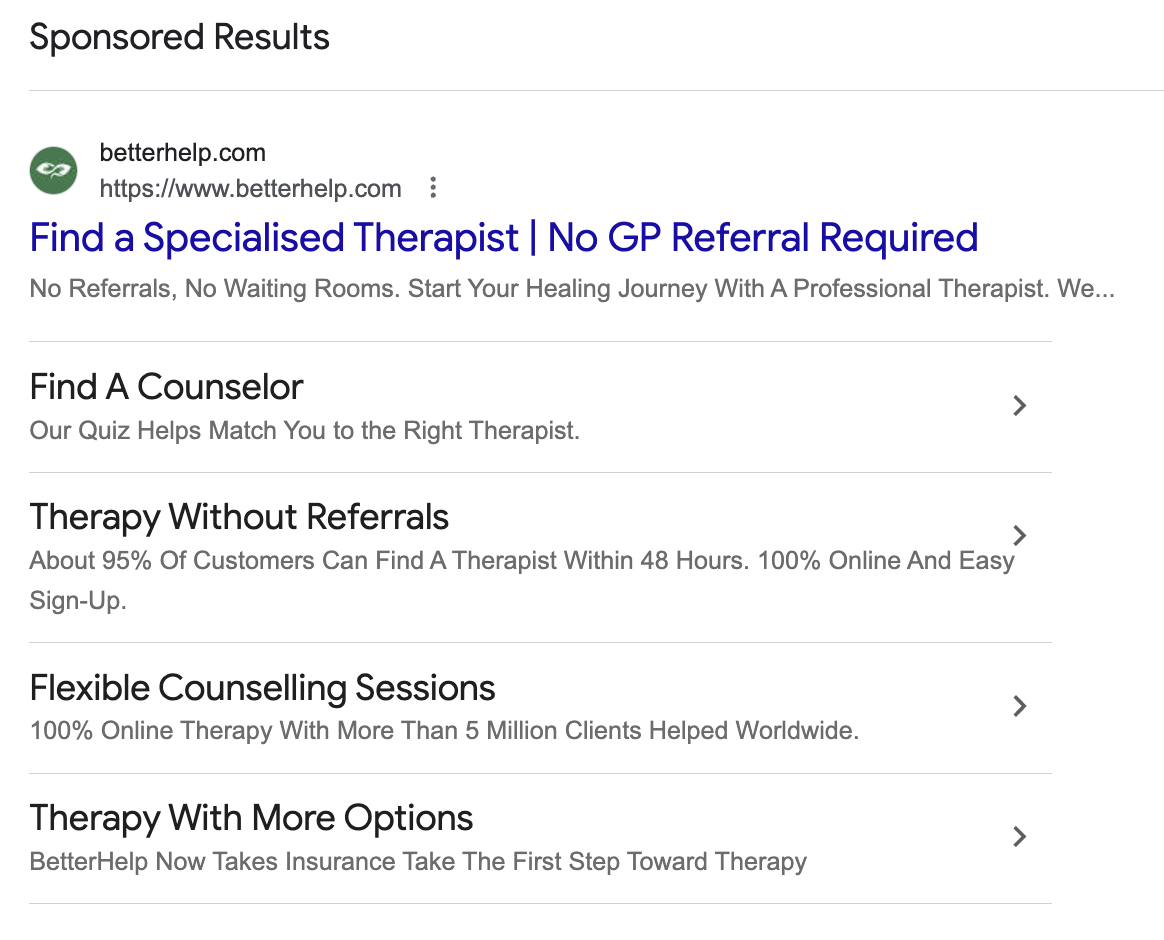
Use this to think about the questions your own potential clients need answered. Don’t copy another advertiser’s claims, availability figures or insurance wording. Your ad needs to describe what your practice actually provides.
4. Set a Budget You Can Afford to Test
When I recently looked at therapist searches around my local area, I saw indicative costs of roughly £2–£8 per click. That is a local observation, rather than a UK benchmark or a quote for your account. Costs vary with your keywords, location, competition and ad performance.
Check current estimates for your own services and area in Keyword Planner. Bid estimates help you plan, but they are not a guaranteed price for each click.
A useful starting point is to budget for 10 clicks per day. Multiply your estimated cost per click by 10 to get a daily budget, then multiply that by 30.4 to estimate the monthly budget.
For example, at £5 per click:
- £5 × 10 clicks = £50 per day
- £50 × 30.4 = £1,520 per month
This gives you a planning figure, rather than a forecast of results. Adjust it to what you can afford and review how many worthwhile enquiries those clicks generate.
You then need to ask how many enquiries become paying clients and whether the income justifies the advertising and management costs. My guide on how much you should spend on Google Ads explains how I approach setting a budget.
5. Check Your Landing Page and Conversion Tracking Before Launch
Before setting your ads live, make sure the page people arrive on explains the relevant service, who provides it, whether appointments are local or online and how to enquire. Qualifications, fees and appointment information can help people decide whether to contact you, where appropriate.
Then test the actions you want to measure:
- Successful contact form submissions
- Completed appointment bookings, if available
- Phone number clicks
- Calls from ads or your website, where supported and configured
A phone number click does not prove that a call connected or became a genuine enquiry. Keep that distinction clear when reviewing results, and avoid treating repeated clicks or failed form submissions as new leads.
Read my guide on testing Google Ads conversion tracking before launch. For therapy enquiries, keep the measurement focused on the action: don’t send form answers, symptoms or other sensitive details to advertising tools. Google also restricts enhanced conversions involving sensitive categories, so check its customer data policies before enabling that feature.
Once you’ve checked the targeting, keywords, ads, budget, landing page and tracking, you can launch the campaign and monitor the first results.
6. Review Search Terms, Negative Keywords and Ad Times
Setting the campaign live is the start of the work. Check what people actually searched for before clicking, whether those searches match your services and whether the enquiries are relevant.
For a private therapy practice, searches about jobs, training courses or qualifications may be irrelevant. You might also need to exclude searches for free services if that isn’t what you offer. Use negative keywords carefully so that you don’t block genuine potential clients.
My guides on finding your search terms and checking negative keywords cover this in more detail.
If you mainly take enquiries by phone, run ads when someone can answer. Paying for calls while you’re unavailable can waste opportunities. If people can complete a form or book online outside office hours, a wider schedule may make sense, provided you follow up promptly. Here’s how to set an ad schedule.
How Should Therapists Judge Google Ads Success?
I normally recommend allowing at least three months to properly assess Google Ads, provided you have an affordable test budget and are actively improving the campaign. That is my recommendation, rather than a guarantee that results will improve after a fixed period.
Early performance can be uneven. As useful conversion data comes through, conversion-based bidding has more information to work with. However, waiting longer will not fix irrelevant keywords, broken tracking or a page that makes it difficult to enquire. Check those issues from the beginning.
Look beyond clicks and review your cost per genuine enquiry, how many enquiries turn into first appointments and your cost per new paying client.
Therapy can involve several appointments, so one new client may generate more income than the first session alone. Use your actual attendance, fees and costs to assess that value, rather than assuming every client will return for a set number of sessions.
Some clients may also recommend you to others. That can add value over time, but I wouldn’t rely on future referrals to justify a campaign that isn’t affordable now. For more on the early stages, see how long Google Ads take to work.
Can Google Ads Help Your Therapy Business Get More Leads?
Yes, Google Ads can help you reach people actively searching for therapy, particularly in your local area. SEO can be competitive, and Search ads offer another way to appear near the top of relevant results while your organic visibility develops.
The important thing is to connect the right search with a relevant ad, a clear landing page and reliable enquiry tracking. Keep reviewing lead quality and the cost of acquiring a paying client as the campaign develops.
If you’d like help setting up Google Ads for your therapy business, get in touch with me. Already running ads? Request a free Google Ads audit and I’ll take a look at where your budget is going and what could be improved.