

If you’ve opened Auction Insights in Google Ads, you might have spotted the column called Outranking share.
There’s a percentage next to each competitor. But is that how often they’re beating you, or how often you’re beating them?
It’s easy to read it the wrong way round. In this blog post, I’m going to explain what outranking share means, how it differs from the other figures in the report and when I would actually do something about it.
What Does Outranking Share Mean in Google Ads?
Outranking share measures how often your advert ranked above another advertiser’s advert, or appeared when theirs didn’t.
The percentage on a competitor’s row refers to you outranking them. It does not show how often that competitor outranked you.
That’s the main thing to get right before you start making changes. A higher percentage means you’re winning that comparison more often, although it doesn’t tell you whether those appearances are generating worthwhile enquiries or sales.
You can find the official definition in Google’s Auction Insights guidance.
What Does a 40% Outranking Share Mean?
Imagine the row for a competitor shows an outranking share of 40%. That means you won the comparison in roughly four out of ten of the relevant auctions.
There are two ways that can happen: both adverts appeared and yours ranked higher, or yours appeared and theirs didn’t.
It does not mean you were the first advert on Google 40% of the time. It is a comparison with one advertiser, so you could rank above them while another business still appears above you.
It also doesn’t mean the competitor was above you for the remaining 60%. Your advert may not have appeared in some of those auctions. This is why I wouldn’t try to work out a competitor’s position simply by subtracting your outranking share from 100.
Where Do You Find Outranking Share?
Open Campaigns → Insights and reports → Auction Insights, then look for the Outranking share column. You can also select an eligible campaign, ad group or Search keyword and open Auction Insights from that view.
Choose the campaign you actually want to review and check the date range before comparing competitors. Looking at the whole account can mix together services with very different competition.
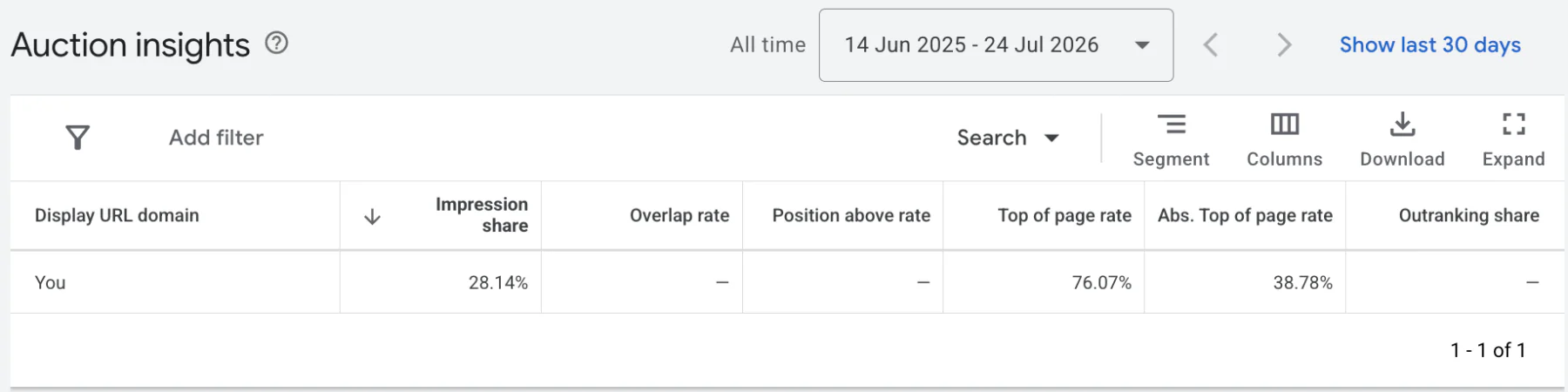
If you need help getting to the report, I have a separate guide on how to find Auction Insights in Google Ads.
What Is the Difference Between Outranking Share and Position Above Rate?
These columns look similar, but they answer different questions:
- Outranking share: how often you ranked above that advertiser, including occasions when you showed and they didn’t.
- Position above rate: how often that advertiser appeared above you when both adverts showed.
- Overlap rate: how often that advertiser also showed when your advert appeared.
Notice that the direction changes. Outranking share looks at you winning the comparison; position above rate looks at the other advertiser appearing above you.
Because they use different comparisons, the percentages do not have to add up to 100%.
What Is a Good Outranking Share?
I wouldn’t give every business the same target. A campaign advertising your own brand, a local service campaign and a campaign targeting competitor searches have different jobs.
For example, imagine you’re a plumber in Leeds. You might see a national company appearing regularly alongside you. Trying to beat them in every auction could mean paying more for clicks without getting enough extra jobs to justify it.
I would start with the business results:
- Are the enquiries relevant?
- How much does a genuine enquiry cost?
- How many turn into paying customers?
- Can the business afford to acquire more customers at that cost?
A lower outranking share can be perfectly acceptable if the campaign is doing its job. Equally, a high percentage gives you little to celebrate if the enquiries are poor.
Should You Try to Increase Your Outranking Share?
If you’re losing visibility on searches that bring profitable work, it’s worth investigating. I would check the search terms, advert relevance and landing page before deciding that the answer is simply to bid more.
Then look at the campaign’s budget and bidding targets. A Limited by budget status or a restrictive CPA or ROAS target can be useful context, but neither is an instruction to spend more regardless of the return.
If you do make a change, compare a sensible period afterwards and judge the extra enquiries or sales alongside the extra cost. Winning more auctions is only useful if you want the traffic you’re winning.
Does Outranking Share Affect Organic Rankings?
No. This is a paid advertising metric. It doesn’t tell you whether your website ranks above a competitor in the organic results.
Keep your Google Ads review focused on paid campaign results, and review organic visibility separately.
How Should You Use Outranking Share?
Use it to understand a change in visibility or investigate a particular competitor. Keep the campaign and date range consistent, then look at what happened to the results you actually care about.
I wouldn’t increase a client’s spend just to make this percentage look better. I’d want a clear reason to believe the extra visibility could bring worthwhile business.
If you’d like help understanding what your Google Ads account is telling you, get in touch with me. I can help you work out which changes are worth making.